0 Comments
A new report looks at 15 business fields to determine the best day of the week to share content on Facebook for engagement. Click to view industry: 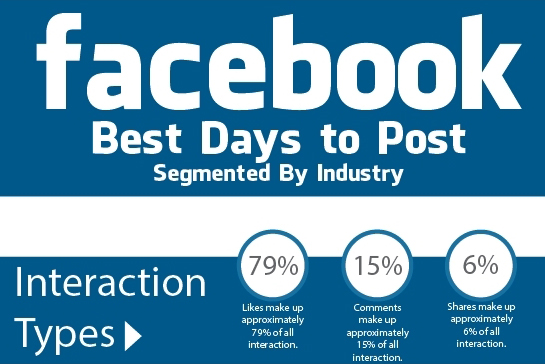
If you’re building your business brand in today’s marketplace, you need to stand head and shoulders above the crowd of other businesses competing for your customers’ attention.
Furthermore, you need to track how effective your brand building is, by monitoring it closely and reacting accordingly. Your brand could well be your most valuable business asset and can mean the difference between a lifetime of loyal and avid customers, or simply being lost in the crowd of other brand marketers on Facebook and Twitter. Let’s look at five ways for you to measure and track your brand in today’s online world. 1. Are Your Fans Engaging With You? Social media and the internet has changed the way we do business. Gone are the days when you marketed to your customers. These days marketing is a two way conversation, with social engagement taking place between the business and consumers. Relationships are built by being responsive to your customers needs. A great example of fan engagement is the French telecommunications company, Orange, who used Twitter to engage their fans. Followers were asked to use the hashtag #thissummer to tweet about the plans they had for summer, which were then broadcast on Orange's blog, with a Voice Over. This had the twofold effect of both creating massive traffic, and enabling people to identify with Orange around an interesting and enjoyable topic. 2. How Much Real Value Are you Adding To The Conversation? The content you offer needs to be the sort that people enjoy and encourages them to share with others, just like Healthy Choice did. They increased engagement with their followers, and gained an extra 10,000 fans by offering a low value Facebook coupon, which increased in value as their fan base grew. This not only reinforced their brand image with existing customers, but the majority of new fans also subscribed to their newsletter. 3. Are You Trying To Take More Than You're Giving? Social media is about building a loyal and responsive following, by giving often, and taking infrequently. Think of it as a savings account. You must put in regular deposits, so you can reap the benefits when you need to make a withdrawal. Giving freely without asking for something in return will translate to massive positive response from your fans when you do decide to ask for something. 4. Are You Actually Listening To The Online Conversation? Today’s customer is a powerful being, with the ability to impact your business in a matter of minutes. It’s therefore essential that you’re listening to the conversation that’s going on all around you, so you can respond to any negativity before it wreaks havoc with your business. Learn from U-Haul’s mistake, who suffered long term damage to their well established brand, as well as lost thousands of dollars, because of a negative conversation about them which they weren’t listening to. Even negative feedback can turn into a positive experience because it shows others that you’re concerned and responsive to their issues. 5. Is Your Website Active With Engagement, or Is It Silent And Stagnant? Just having a website, no matter how flashy or attractive you think it is, simply isn’t enough anymore. Build it and they will come is an internet myth. Customers want to visit websites and blogs on which they can find interesting and engaging information, and which they want to bookmark and return to often because they look forward to your new content. A simple way to encourage your website visitors to engage with you is to end your articles and blog posts with a question that encourages the reader to respond. What do you want most out of your marketing efforts? Ask yourself these questions:
Over 85% of people contact businesses they find in local searches. That's why 100% of businesses need to be online! Your local business has many options, to remain current online such as a website, business facebook page, social networks, videos, blogs, online ads, etc. Even for businesses with a limited marketing budget, there are ways to promote your business online. Here are 10 free ways to promote your business online:
The nuts and bolts of SEO marketing are keywords. They are important for one reason and one reason only. They allow businesses who seek search engine rankings to target their rankings by using the correct language.
If you think about it, this is what good marketing has always done. Marketers deploy language for the purpose of persuasion. They hope to get their target audience to think about things by using the correct language and getting them to think and take action. SEOs do this using a specific type of language that is intended for two audiences. The first audience is the human audience. You want your online content to speak to your human target audience in a way that your human audience takes action. That action, you hope, is to do business with you. Your second audience is the search engines. Or their spiders. Search engine spiders are computer programs that crawl the Web through links and analyze the content on the pages. Today's search engine spiders are very sophisticated compared to the spiders of fifteen or twenty years ago. They analyze keywords, links, images, and a host of other on-page and off-page factors to determine the rankings of web pages for specific key phrases. Because search engines have a ranking system, search engine optimizers try to target their content to the spiders in order to influence them on that ranking system. The goal is to increase their chances at getting good rankings. Keywords are the nuts and bolts, the basic building fundamentals, of good SEO. If you want to rank well, start with good keyword research. Website design is both an art and a science. There is something about a unique website design that keeps visitors returning and customers buying. No matter what type of business you are in, here are 5 practical web design tips that can help you as you build your first business site online.
Follow these 5 simple and practical tips the next time you design a website and you will improve your prospects for higher rankings, more visitors, and better results. |

Archives
February 2024
Categories
All

|

![11 Essential Ingredients Every Blog Post Needs [Infographic]](http://netdna.copyblogger.com/images/650/essential-blog-post-ingredients-infographic.jpg "11 Essential Ingredients Every Blog Post Needs [Infographic]")
 RSS Feed
Website Design Gettysburg | Services | Website Designer Near Me | Prices | Contact Gettysburg Website Design | Design Blog
From Our Blog
3 Steps to Improve Your Google Business Listing Ranking • Search Engine Optimization + GMB = More Leads & Sales! • Website SEO Checklist
Secrets To Building an Appealing Website For Any Niche
Secrets To Building an Appealing Website For Any Niche
|
Crawford Designs, LLC
Gettysburg Website Design |
© 2021 Gettysburg Website Design.
717-855-3184 |
SERVICES: Website Design, Local Gettysburg Website Design Services, Website Design Company, Website Development Company, Freelance Web Designer, Web Design Company, Web Development Company, Business Websites, Corporate Websites, Business Marketing and Advertising. Website Maker, Web Site Creator, Web Builder, Done For You Websites, Hire a Website Designer, How to Get a Business Website, best website design companies for small business, website design pa, website for small business owners, web design and marketing company, top website design company, york county web design, local web design companies near me, small business web design near me, web design westminster md, web designers in hanover pa, small design companies

